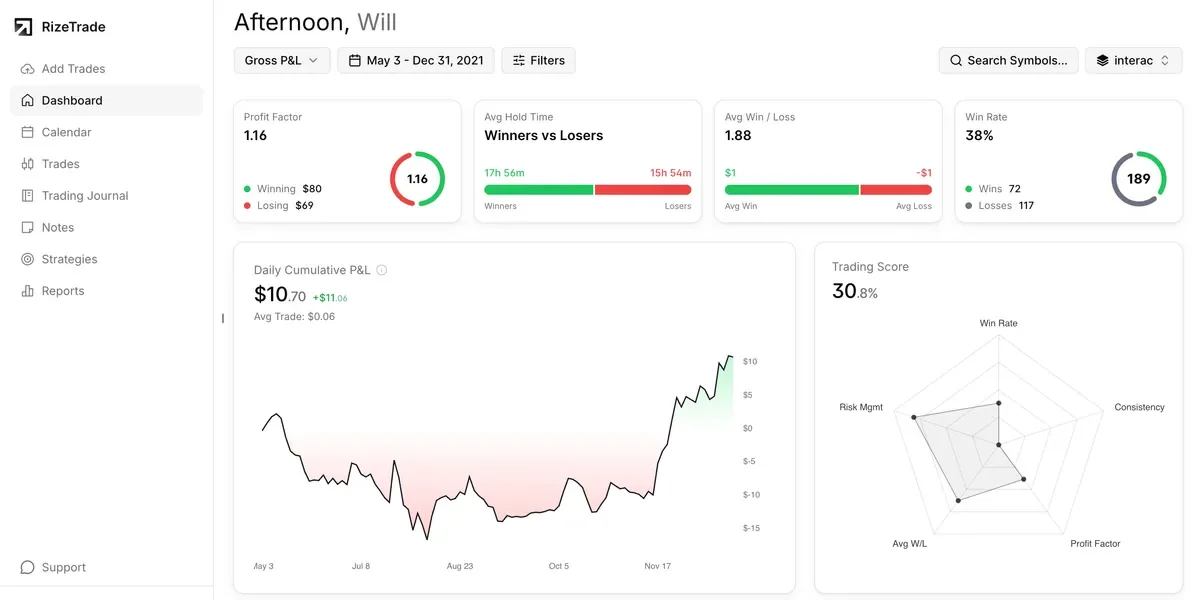
A trading journal is a record of every trade you take — plus the decisions, emotions, and reasoning behind each one.
It tracks more than just P&L. A good trading journal captures:
What you planned to do before the trade
What you actually did during the trade
How you felt while it was happening
What the outcome was
What you learned from it
A trade log tells you what happened. A trading journal tells you why it happened.
Your broker already gives you a log of executions. Entry price, exit price, P&L. It doesn't explain why you entered late, why you moved your stop, or why you took that random trade out of boredom at 2 PM on a Tuesday.
A trading journal adds the context that makes you improve.
Why Most Traders Stay Stuck Without One
Pain: You've been trading two years and you're still up and down between green months and blown weeks.
Pain: Every losing streak makes you think you need a new strategy.
Answer: You don't have a feedback loop. Trading without one is expensive guessing.
Traders fail when nothing forces them to confront what's really happening. They don't review. They don't track patterns. They trade the same way every day and hope for different results.
A trading journal builds the feedback loop.
You Keep Repeating the Same Mistakes
You know you shouldn't chase candles. You know you shouldn't hold losers past your stop. You know revenge trading after a loss always makes it worse.
But you keep doing it. Why?
Because you're relying on memory. And memory is unreliable — especially after a stressful session.
When you write it down, you create a record you can't argue with. You start to see the pattern. Maybe you overtrade every Monday. Maybe you break your rules after two losses in a row. Maybe you hold losers twice as long as your winners.
A trading journal exposes mistakes you'd otherwise miss.
You Don't Know What's Actually Working
Which of your setups makes the most money over 50, 100, or 200 trades?
Few traders can answer that. They run multiple strategies, multiple time frames, and multiple instruments — and they have no idea which combination is paying them and which is bleeding the account.
Without data, you're guessing. A journal gives you the numbers.
Maybe your pullback trades on NQ have a 65% win rate and a 2.1 profit factor. Maybe your breakout trades on small caps lose money every month. You'd never know that without tracking it.
Your Emotions Run the Show
Trading is emotional. One bad trade spirals into FOMO, revenge trading, and tilt. A $300 loss turns into a $3,000 day.
You already know this happens. Seeing it clearly is what lets you stop it.
When you tag trades with how you felt — anxious, overconfident, frustrated, bored — and then look at the data, the cost of emotional trading becomes a dollar amount.
When you can see that FOMO trades cost you $2,000 last month, or that your win rate drops to 14% on days you slept badly, your behavior changes. The evidence sits right in front of you.
Your Memory Lies to You
Traders remember their wins more clearly than their losses. They remember trades slightly differently than they actually happened. They inflate the good ones, forget the bad ones, and tell themselves a flattering version of the story.
A journal records what actually happened, not what you remember.
What a Trading Journal Actually Tracks
A trading journal doesn't have to be complicated, but it has to be consistent. Every trade gets the same treatment.
The Basics
The simple facts about the trade:
Date and time — when did you enter and exit?
Instrument — what did you trade? (ES, NQ, AAPL, EUR/USD, BTC, options, etc.)
Direction — long or short?
Position size — how many shares, contracts, or lots?
Entry price and exit price
Stop loss and profit target — your planned exit on both sides
P&L — the final number
Your Plan vs. What Actually Happened
Before you enter, you have a plan. A setup. An entry trigger. A stop. A target. Write it down.
After the trade closes, compare the plan to reality.
Did you follow your entry criteria, or did you jump in early?
Did you respect your stop, or did you move it?
Did you hit your target, or did you exit early because you saw a little green and got nervous?
The gap between your plan and your execution tells you everything. If you planned a 3R trade and walked out with 1R, you left money on the table. If your stop was at -1R and you actually lost -4R, you have a stop loss execution problem.
A trading journal exposes whether the problem is your strategy or you.
How You Felt
Write down your emotional state before, during, and after the trade.
Were you confident? Anxious? Bored? Frustrated from the last trade? Chasing because you missed a move?
When you tag your trades by emotion and run the numbers, you'll find patterns like:
Trades taken in a state of FOMO lose 80% of the time
You overtrade when you're frustrated
Your best trades happen when you feel calm and patient
On days you skip your morning routine, your win rate falls off a cliff
Real traders find these patterns in their data.
What You Learned
After every trade, write one or two sentences about what you learned.
"I followed my plan. The setup didn't work today. That's okay."
"I moved my stop because I panicked. If I'd held, I'd have hit target."
"Boredom trade. No real setup. I need to walk away when the tape is slow."
Over time, those notes become a personal playbook.
7 Ways a Trading Journal Makes You a Better Trader
1. Spot Patterns You Can't See in Real Time
When every trade gets logged the same way, patterns start jumping out. You see which days of the week are your worst. Which time windows are profitable. Which setups print and which ones bleed.
One trader figured out every Monday was a red day. Why? Long weekend, came back too aggressive, sized up too fast. He'd never noticed it without the journal.
Another trader found all his profits came before 10:30 AM ET. Everything after that was giving money back. The journal made it obvious. He adjusted — and his results changed inside a month.
2. Stop the Emotional Spiral
A bad trade happens. Then another. Suddenly you're revenge trading, sizing up to "make it back," and your $500 loss is a $2,500 disaster.
A journal helps in two ways.
First, awareness. When you check in with yourself every 15 to 30 minutes — "How am I feeling right now? Am I on tilt?" — you catch the spiral before it goes off the rails.
Second, a dollar cost. When the data shows revenge trades lose 85% of the time, you think twice before clicking.
3. Find Out Which Strategies Actually Work
You might be running three or four setups. A journal lets you compare them side by side with real performance data.
Maybe your pullback strategy has a 60% win rate and a strong profit factor. Maybe your reversal strategy has a 25% win rate and is deep in the red. Without a journal, you keep running both. With one, you cut the loser and double down on the winner.
4. Fix Your Position Sizing
Inconsistent sizing is one of the most common problems traders have — and one of the hardest to spot without data.
You risk $500 on one trade, $2,000 on the next, $300 on the one after that. Your sizing swings on emotion.
When your sizing is all over the place, your results are meaningless. You can't tell if a losing week came from bad setups or one oversized trade.
A trading journal tracks your risk per trade in R terms. It shows you exactly where oversizing hurt you and where consistent risk would have kept you in the game.
5. Build Real Discipline
When you know every trade gets logged — the good, the bad, and the embarrassing — you think more carefully before clicking.
Being forced to write down: "I took a trade with no setup because I was bored" changes behavior. You do it once. Maybe twice. By the third time, you stop, tired of writing the same mistake.
That's accountability you create for yourself.
6. Track the Metrics That Actually Matter
P&L is one number. A trading journal tracks the metrics that reveal the full picture:
Win rate — what percentage of your trades win?
Average win vs. average loss — are your winners bigger than your losers?
Profit factor — total profits divided by total losses. Above 1.0 means you're net positive.
R multiple — how much you made relative to what you risked
Maximum drawdown — how deep did you go in a losing stretch?
Trade expectancy — your expected return per trade based on your track record
These numbers tell you whether your approach has an edge.
7. Know When to Trade and When to Walk Away
Time-of-day data is one of the most useful things a journal shows you.
A lot of traders find out most of their profits come from the first 90 minutes of the session. Everything after that is flat or negative. Some find specific 15-minute windows that consistently cost them money.
When you see that data, the decision is simple: trade your good hours, skip your bad ones. Your P&L improves without changing your strategy.
"I Tried Journaling Before and Quit" — Why This Time Is Different
If you've tried keeping a journal in the past — a spreadsheet, a notebook, a Word doc — and it fell apart, you're not alone. Most traders have been there.
The tool was the problem.
Manually entering every trade into a spreadsheet is exhausting. Building formulas to calculate your metrics is a chore. Organizing screenshots across folders is a mess. By the time you finish logging, you have zero energy left to review anything.
And after a bad day — the day you need to journal the most — the last thing you want to do is sit down and type out everything that went wrong.
So you skip a day. Then a week. Then you stop altogether.
That's a friction problem.
Modern trading journal software solves it by auto-importing your trades straight from your broker. No manual entry, no formulas, no copy-pasting. Your trades show up automatically, plotted on charts, with metrics calculated for you.
The only thing you add is your notes, your tags, and your reflections. The whole thing takes a few minutes.
If you tried journaling before and quit, the method wasn't sustainable.
How to Actually Use a Trading Journal (Daily Workflow)
Knowing what a journal is and using one every day are two different things. Use this workflow.
Before the Market Opens
Set aside time before the session. 30 to 60 minutes minimum.
Check the economic calendar. FOMC? CPI? NFP? Earnings?
Note what happened in the previous session. Where did price close? What's overnight doing?
Build 2 to 3 "if/then" scenarios. "If price breaks above this level, I look for longs on a pullback. If it rejects, I look for shorts below this zone."
Write down personal reminders. What was your biggest mistake last week? What rule do you have to follow today?
Check in with yourself. How did you sleep? How's your energy? Are you distracted? If the answer is bad, reduce your size — or don't trade at all.
During Your Session
Every 15 to 30 minutes, pause and check in.
How am I feeling right now?
Have I taken any trades outside my plan?
Am I close to my max loss for the day?
Am I chasing or revenge trading?
If you feel yourself going on tilt, write it down. That alone — naming the emotion — creates enough distance to break the spiral.
Before every trade, take 10 seconds. Ask: "Does this fit my plan?" Anything less than an immediate yes is a no.
After Each Trade
Log the trade. If your software syncs with your broker, the data imports automatically.
Then add:
Which setup or playbook does this trade belong to?
Did you follow all your entry rules?
What was your planned risk and target?
How did you feel during the trade?
Tag it: setup type, emotional state, confidence level, market condition
A note or two on what you learned
2 to 5 minutes per trade.
End-of-Day Recap
After the close, review your day and your process.
Did you follow your game plan?
What were your top 2 to 3 mistakes?
What did you do well?
Any setups you missed? Why?
Grade your execution, not your profit.
A green day where you broke every rule is a bad day. A red day where you followed your process is a good day.
Weekly and Monthly Reviews
Once a week, zoom out.
Which setups performed best?
Which time windows made money? Which lost?
Did you follow your playbook, or did you take random trades?
What was your biggest recurring mistake?
One specific thing to fix next week.
Once a month, look closer.
Compare performance across strategies with real numbers
Review your R multiple distribution — are you actually following your stops?
Look at your emotional tags — which feelings correlate with losses?
Set 1 to 2 focused goals for the next month
The Real Cost of Not Keeping a Trading Journal
What you give up trading without a journal:
You can't find your strengths. Without data, you don't know which setups make money. You keep running all of them — including the ones bleeding you.
You can't learn from your mistakes. You repeat the same errors over and over because nothing forces you to confront them.
You can't track progress. Without a record, every month feels like starting from zero. You have no way to see if you're improving, stalling, or getting worse.
You can't manage risk. You don't know if your sizing is consistent, if you're respecting your stops, or if your average loser is three times bigger than your average winner.
You can't build the case to size up. When you want to trade bigger, you need proof that your edge is real. Without a track record, sizing up is just gambling with more money.
You keep fooling yourself. Your memory tells you you're doing fine. The data tells a different story — and without it, you'll never know.
The cost of not journaling is the time you lose and the money you keep giving back on problems a journal would have surfaced in days.
How RizeTrade Makes Journaling Simple
The biggest reason traders don't journal is friction. Manual entry is tedious. Spreadsheets break. Notes get scattered across five different apps. RizeTrade removes the friction.
Auto-Import Your Trades
Connect your broker and your trades import automatically. No typing, no formulas, no copy-pasting from your platform. Trades from thinkorswim, Interactive Brokers, TradeStation, Webull, and more flow straight into your journal. You spend your time reviewing instead of entering data.
See What's Working (and What's Not)
RizeTrade breaks down your performance by strategy, by instrument, by day of the week, by time of day in 15-minute windows, and by any custom tag you create. You can see that your pullback trades on ES have a 62% win rate while your breakout trades are in the red — without building a single formula.
Track Your Emotions and Find the Patterns
Tag every trade with your emotional state — FOMO, revenge, boredom, overconfidence, calm, focused. Then filter your reports by those tags. When you see that revenge trades cost you $3,200 last month, the behavior changes.
Measure Planned Risk vs. Actual Result
RizeTrade tracks your planned R multiple against your realized R multiple for every trade. If you planned a 3R winner but walked away with 1R, you see it. If your stop was at -1R but you actually lost -4R, the data shows you the exact dollar cost of not following your stop.
Pre-Market Prep and Daily Journal Templates
RizeTrade gives you structured templates for your pre-market game plan, intraday check-ins, trade recaps, and weekly reviews. You fill in the prompts. The structure is built for you.
Charts With Your Entries and Exits Plotted Automatically
No more taking screenshots and saving them in folders. Your entry and exit points appear on the chart inside your journal. You can see exactly where you got in, where you got out, and what happened afterward.
A Progress Tracker for Discipline
Set your daily rules — max loss, max trades, stop time — and track whether you followed them. The goal is to measure discipline, not just P&L.