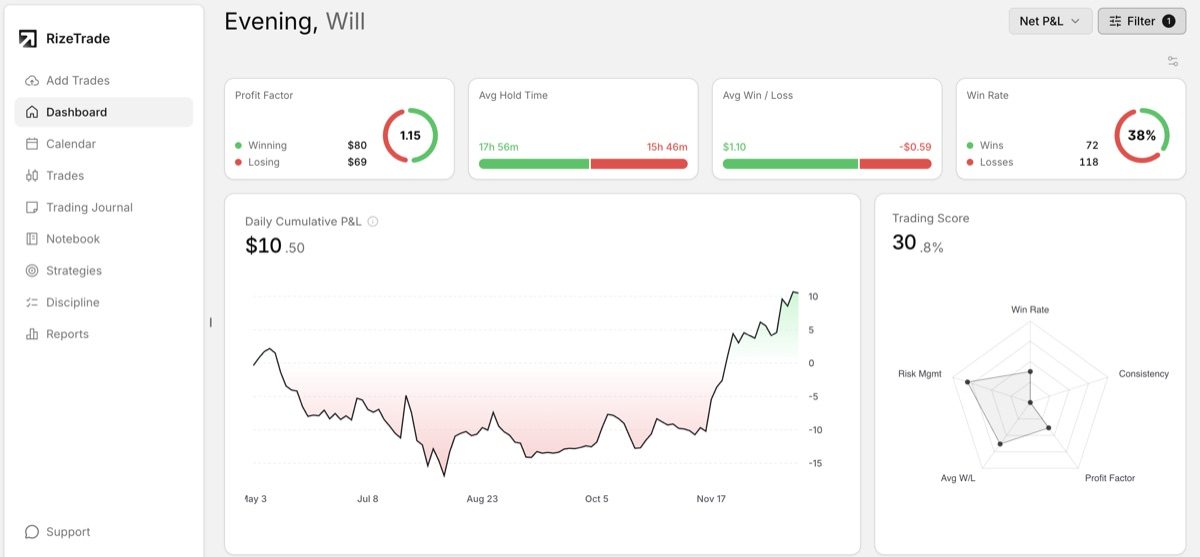
The short answer
Yes — for a specific type of trader. If your problem is behavioral (you have a strategy but blow it in live markets through revenge trades, overtrading, or cutting winners early), RizeTrade is one of the most purpose-built tools available. It doesn't just log your trades — it quantifies exactly what each behavioral pattern is costing you in dollars, and shows what your account would look like without the drag. If you need tick-level scalping replay or the deepest AI coaching assistant in the market, compare it against alternatives first. For discipline-first traders, it's hard to beat.
What RizeTrade actually is
RizeTrade is a web-based trading journal and analytics platform. It's not a broker, not a screener, not a charting suite. It does one job: takes your execution data from 800+ brokers, runs it through 50+ auto-generated reports, and shows you where your edge lives and where your behavior is destroying it.
The platform is organized around five specific problems most active day traders face. Each one has dedicated analytics built around it — not as a checkbox feature, but as the structural core of the product.
The five problems RizeTrade is built to solve
1. Overtrading
Most blown accounts are a discipline problem, not a strategy problem. RizeTrade tracks trades per session, flags boredom trades and revenge entries directly on the calendar, enforces daily max-loss and max-trade limits, and visualizes rule adherence on a color-coded compliance heat map.
The data answers the question most traders avoid asking: exactly when does "one more trade" turn a green day red? Once you can see it in a heat map, it stops being a vague habit and becomes a quantified pattern with a dollar figure.
2. Lack of discipline
Most traders have rules. Most traders break them and can't prove which breaks cost money. RizeTrade converts playbooks into checklists, calculates a compliance percentage per strategy, and compares your win rate when rules are followed versus when they aren't.
That last number is the diagnostic. If your rule-compliant win rate is 58% and your non-compliant win rate is 31%, the gap isn't motivational — it's financial. You can show it to yourself on a chart and make a decision accordingly.
3. Emotional trading
Emotion tags (revenge, FOMO, tilt, boredom, chasing, impatience) attach to individual trades. RizeTrade generates a tag-based P&L report showing the exact dollar cost of each pattern.
The standout feature here is the P&L simulation with emotional trades removed — it shows precisely what your account balance would look like without the behavioral drag. For most active traders, that number is sobering enough to change behavior where no book, coach, or framework has.
4. Risk management
RizeTrade tracks R-multiples per trade — planned versus realized — so a stop-loss violation shows up in the numbers immediately. MAE/MFE analysis (Maximum Adverse Excursion / Maximum Favorable Excursion) reveals whether you're holding trades too long or cutting them too short. Stop-loss and take-profit adherence are tracked per trade.
This is the layer that matters for funded traders and prop firm accounts. Rule adherence isn't just a habit tool — it's a pass/fail condition for keeping a funded account, and RizeTrade tracks it at the trade level.
5. Cutting winners early
The exit efficiency score expresses actual profit captured as a percentage of maximum available profit. Best Exit P&L compares your actual exit to the best achievable exit across all trades.
Most traders feel like they cut winners too early but can't quantify it. This score makes it concrete. When you see your exit efficiency sitting at 54%, you have evidence-based justification to hold longer — not a hunch.
Mentor AI: automated post-trade coaching
Mentor AI is RizeTrade's AI-powered post-trade coaching tool, and the platform's only paid feature — $29/month, or $276/year. After each session it walks through a guided review — structured questions on decisions, emotions, and rule adherence.
What makes it practically useful: Mentor AI automatically extracts emotions experienced, rule adherence per trade, setup quality, and key takeaways, then auto-populates tags, compliance scores, and journal entries. It eliminates the two main reasons traders stop journaling — manual tagging and the blank-page problem. The post-session review becomes a guided conversation rather than a data entry task.
The analytics layer: 50+ reports, no formulas
RizeTrade builds all reports automatically. The ones that matter most for day traders:
Report | What it answers |
|---|---|
Time-of-Day | P&L by day of week and 15-minute block — which hours make you money, which drain the account |
Symbol / Instrument | Win rate and P&L by ticker — where you actually have edge |
Strategy | Side-by-side playbook comparison with real performance data — stops strategy-hopping |
Tag-Based | Auto-generated per custom tag — dollar cost of revenge trading, poor sleep, or any variable you track |
Risk / Position Size | How sizing affects win rate and P&L — finds the sweet spot before scaling |
Trade Duration | Performance by hold time — reveals whether trades are held too long or cut short |
MAE/MFE | Maximum adverse and favorable excursion per trade |
Exit Efficiency | Actual profit captured vs. maximum available |
Commission / Fee Tracking | True net P&L after all costs |
Display modes: Dollar · Percentage · R-Multiple · Ticks · Privacy Mode.
The time-of-day breakdown alone justifies setting the journal up, and it's on the free plan. Nearly every trader has a 1–2 hour window where they perform well and a later window where they give it back. This report makes that split visible — and gives you permission to stop trading when your edge disappears.
Journaling and daily structure
RizeTrade's journaling tools are built around removing friction from a habit most traders abandon:
Daily Journal — Structured templates with pre-built prompts. Captures trade reasoning in seconds.
Premarket Prep — If/then scenario planning templates replace reactive trading with a structured session plan.
Notebook — Folders for weekly recaps, monthly reviews, trading plans, goals, and watchlists.
Missed Trade Tracking — Log setups seen but not taken. Processes phantom trades constructively instead of letting them trigger FOMO entries. This is an underrated feature — most traders either ignore missed trades or let them create emotional pressure that leads to chasing.
Voice Notes — Audio recordings attached to trades for in-the-moment reflections.
Attachments — Screenshots, videos, and chart annotations per trade in one place.
Who it's built for
Strong fit:
Day traders with a defined strategy who are underperforming it in live markets
Traders who know their setup works on paper but lose money to emotional execution
Prop firm and funded account traders who need documented rule adherence
Multi-asset traders — stocks, options, futures, and forex are all supported
Anyone running 800+ supported brokers who wants automatic imports instead of manual CSV uploads
Traders switching off spreadsheets who want automated reports without building formulas
Less strong fit:
Scalpers who need tick-level trade replay with Level 2 data precision (TradeZella leads here)
Beginners with no defined strategy yet — the discipline tools assume you have rules to measure against
Traders whose primary need is a natural-language AI coaching assistant rather than structured analytics
Pricing
Free plan
- Price
- $0, forever
- What you get
- The whole journal, no credit card — unlimited trades, unlimited accounts and strategies, all 50+ reports, trade replay, voice notes
Mentor AI
- Price
- $29/mo, or $276/yr (~$23/mo)
- What you get
- Mentor AI (~100 questions/month, top-ups available), invite a human mentor to review your journal
Plan | Price | What you get |
|---|---|---|
Free plan | $0, forever | The whole journal, no credit card — unlimited trades, unlimited accounts and strategies, all 50+ reports, trade replay, voice notes |
Mentor AI | $29/mo, or $276/yr (~$23/mo) | Mentor AI (~100 questions/month, top-ups available), invite a human mentor to review your journal |
The journal is free forever, no credit card, and it doesn't expire. Mentor AI is the only thing you can pay for, and you can cancel it anytime. The free plan gives you as long as you need to import your trades and watch the time-of-day and tag reports populate — which is the fastest way to evaluate whether the platform is surfacing actionable patterns for your specific trading style.
The honest limitations
Discipline tools require a defined strategy. Rule adherence tracking and compliance percentages only work if you've codified your rules into a playbook first. Traders still in the discovery phase won't unlock the platform's best features until they do.
No tick-level replay for scalpers. Trade replay is included, but if your review process depends on millisecond precision and Level 2 data, TradeZella has deeper functionality for that specific use case.
The verdict
RizeTrade is built around a correct diagnosis of why most day traders lose money: not bad strategies, but behavior that diverges from those strategies under pressure. The five core problems it targets — overtrading, discipline, emotional trading, risk management, and cutting winners early — cover the overwhelming majority of behavioral leaks in active trading accounts.
The platform's advantage is specificity. The exit efficiency score, the emotional P&L simulation, the compliance heat map, and the rule-compliant vs. non-compliant win rate comparison are all features that directly answer the question "what is my behavior costing me?" No journal in this tier makes that answer more concrete.
Because the journal is free forever with no credit card, the evaluation is essentially risk-free. Import a month of trades, tag the behavioral patterns, and let the data tell you whether the platform is showing you something worth acting on.
Bottom line: For discipline-first day traders, RizeTrade is among the strongest tools available in 2026 — and the journal costs nothing. Mentor AI, at $29/month, is the only upgrade there is, and the first prevented revenge-trade loss covers months of it. Start on the free plan, run 30 days of tagged data, and let the P&L simulation do the work.